
What I Learned Watching pH7's Extraction Line Run

This is a special guest post written by Pangaea Ventures Analyst Helen Sun.
Six months into my role as an analyst at Pangaea Ventures, most of my work has taken place behind a screen. I spent my days reviewing pitch decks, building financial models, and mapping investment theses. That changed when I traveled to Vancouver to visit the pH7 Technologies facility alongside Pangaea Partner Sarah Applebaum, who serves on the company's board. Watching the plant in operation revealed an essential lesson about hard tech investing: real risk rarely shows up in a single metric. Instead, it hides in hundreds of small, interconnected tradeoffs that only become visible when you watch the physical process unfold.
pH7 extracts high-value platinum group metals, including platinum, palladium, and rhodium, from spent industrial catalysts using a low-temperature, solvent-based process with minimal water usage. On paper, the business case is a clean, lower-cost alternative to traditional smelting. On the factory floor, that theoretical model becomes a dynamic, interconnected system. Watching raw feedstock arrive, pass through successive extraction stages, and emerge as refined output shows how tightly coupled each phase is. A change at one stage of the line immediately alters the operating parameters for the steps before and after it. Feedstock selection, for example, is a strategic choice rather than a routine commodity purchase. Spent petroleum catalysts, automotive converters, and diesel particulate filters each carry distinct chemical compositions and physical constraints. The material with the highest metal concentration may not yield the easiest or most economic extraction.
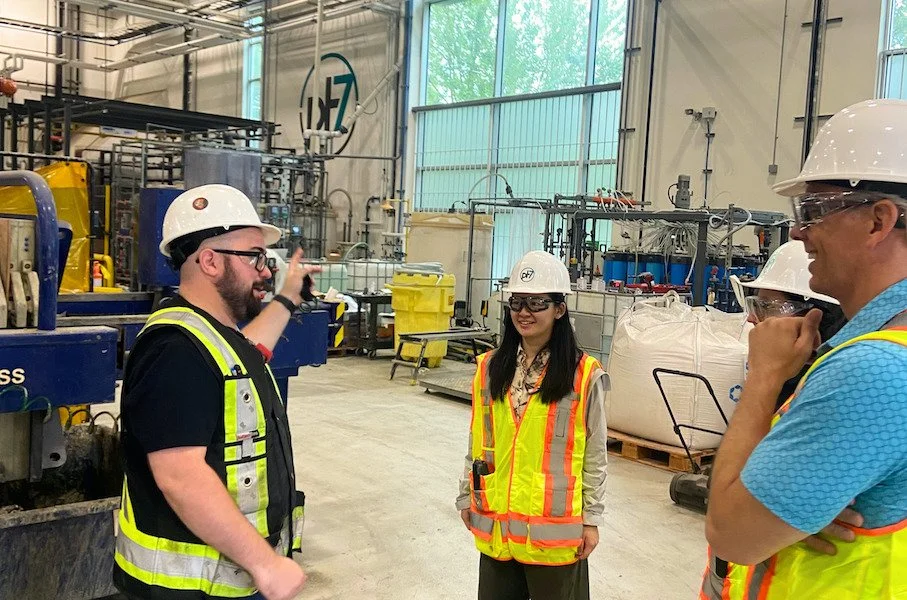
That same interdependence is easy to miss unless you've watched the line run. It's tempting to evaluate yield, spending, and output as if each could be optimized on its own, but that's not how the system actually behaves. Unlike our life sciences investments, where success or failure often turns on one clear result, like a clinical trial outcome, progress here is slower and less visible, accumulating through many small decisions made over time. What matters most is not any single measurement, but the judgment shown in balancing them.
The physical tour also surfaced operational vulnerabilities that rarely stand out in spreadsheet reviews. Equipment categorized as auxiliary, such as air scrubbing hardware, carries vital importance on the floor. For example, a scrubber failure would represent an immediate threat to plant safety, regulatory compliance, and community trust. Seeing the site's backup redundancies in person underscored why operational resilience is just as critical as core chemistry.
Observing Sarah navigate these complexities is a masterclass in systems thinking applied to hard tech. Rather than viewing technical challenges in isolation, she evaluates how every physical tradeoff cascades across the entire business. She zeroes in on foundational questions: whether the unit economics hold under stress, if the target market supports scale, and how operational risks impact enterprise value. Navigating multi-variable businesses like pH7 can trip up standard investor models, but Sarah seamlessly translates physical complexity into clear strategic logic.
Crossing the six-month mark of my investing career, this trip reshaped how I view my work as an analyst. Desk research and external conversations provide necessary baselines, but true understanding requires stepping out from behind the screen. Standing beside the machinery taught me to look past ideal projections and pay attention to the quiet, practical details that ultimately determine whether a technology can scale in the real world.