
Building Hard Tech in the Desert: Why Our U.S. Office Calls Arizona Home

Inset Phoenix image via Matthew Hamilton.
Ahead of our annual LP Meetings & CEO Day and AZ Tech Week next week, we reflect on a question we sometimes find ourselves answering: Why is Pangaea’s US office in Phoenix?
Arizona is not an accident for us. It’s where hard tech, industrial scale, and a new generation of founders are converging into something globally significant, and it has become the natural home for our U.S. office.
When questions come up about why our U.S. office is in Arizona, the answer starts with how we like to work rather than looking at a map. In our early days in Vancouver 26 years ago, we rolled up our sleeves alongside a younger startup ecosystem, offering institutional venture feedback, helping founders mature their companies, and shining a light on under‑recognized innovators.
The period since our move into Arizona in 2019 represents a similar moment in time: we are here to lean in, to support a fast‑developing hard tech ecosystem, to provide a global VC perspective, and to help spotlight a startup community that is growing in both capability and confidence.
Here’s all the reasons we’re in Arizona:
Arizona is a hard tech engine
Arizona has rapidly evolved into one of the most dynamic innovation hubs in the United States, particularly for hard tech sectors including advanced manufacturing, semiconductors, and industrial technologies. The Arizona Commerce Authority (ACA) and regional partners like Greater Phoenix Economic Council (GPEC) have been deliberate in building this ecosystem; aligning tax policy, workforce initiatives, and sector strategies around tangible industry needs rather than slogans.
The result is a state that is not just “startup friendly,” but structurally aligned with the kinds of science‑driven, capital‑efficient businesses we and our Limited Partners (LPs) care about. Arizona’s mix of research institutions, skilled technical workforce, and growing base of industrial facilities makes it an ideal place to build companies that go from lab scale to global production.
A top U.S. city for founders
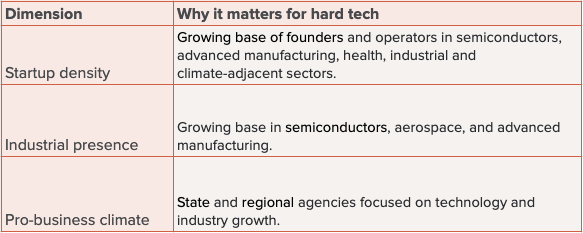
Phoenix is now ranked the No. 1 city in the United States for startups, reflecting the city’s growth in early‑stage activity, access to talent, and supportive business environment. That recognition is not driven by founders building consumer applications alone; it is increasingly shaped by founders building in energy, manufacturing, logistics, materials, and data infrastructure.
We understand that this matters for hard tech founders. They are looking for ecosystems that pair capital and talent with proximity to real factories, suppliers, and customers. Phoenix and Arizona have become that hub, with early‑stage activity clusters around semiconductors, advanced manufacturing, health, and climate‑adjacent sectors. The presence of fast‑growing startups, sector‑savvy investors, and industrial partners in one geography shortens feedback loops and accelerates the path from prototype to scaled deployment.
Ecosystem strengths for hard tech
Universities as innovation pipelines
Arizona’s university system is another major reason our U.S. base is here. Arizona State University is the largest university in the United States, with roughly 150,000 students and around 35,000 engineering students, creating a deep pipeline of technical talent for high‑growth companies. ASU has also emerged as one of the country’s leading patent‑producing universities, recently ranking No. 9 worldwide and No. 5 nationally for U.S. patents issued, placing it among the top innovation universities globally.
This combination of scale and output is especially valuable in hard tech, where companies need sustained access to engineers, scientists, and applied researchers. It also supports a culture of industry collaboration, as seen in ASU’s work around semiconductors and advanced manufacturing that is reshaping Arizona’s economic base. For our founders, this means access not only to new hires, but to ongoing research partnerships and domain expertise across materials, electronics, and process engineering.
Health and bioscience anchors
Alongside the universities, Arizona’s health and life sciences ecosystem is becoming an important anchor for hard tech and deep tech founders in areas like diagnostics, imaging, data, and advanced materials for care delivery. Major institutions such as Mayo Clinic, Banner Health, Honor Health and MD Anderson shape clinical demand and research partnerships in the region, with the Mayo Clinic and ASU MedTech Accelerator providing a dedicated pathway for early‑stage health technology companies to connect with clinicians and validate products. The state has also pushed for practical lab space such as PBC 850 and specialized support organizations, including the Flinn Foundation and its long‑running Arizona Bioscience Roadmap, creating more realistic on‑ramps for bioscience and health‑adjacent hard tech companies that need both clinical access and fit‑for‑purpose facilities.
Industrial scale and global supply chains
In recent years, Arizona has become a focal point for national semiconductor and advanced manufacturing initiatives, supported by major private investments and public programs. Global leaders such as TSMC and Intel are building and expanding advanced logic fabs in the Phoenix area, while companies like NXP and Amkor add depth in power, embedded, and advanced packaging, creating an end‑to‑end silicon supply chain in a single region.
Upstream suppliers including Pangaea LP Chang Chun, which is constructing its first U.S. electronic‑grade chemical manufacturing facility in Casa Grande, further reinforce Arizona’s role as a strategic hub for the semiconductor ecosystem. Federal and state efforts, including workforce and research funding for semiconductor manufacturing, have positioned the state as a strategic node in North American and global supply chains for chips and related technologies. For LPs with manufacturing and industrial footprints in Japan and across Asia, this trajectory is particularly relevant.
As supply chains diversify and resilience becomes as important as cost, Arizona offers a blend of factors that align with long‑term industrial planning: a concentration of semiconductor and advanced manufacturing assets, targeted talent initiatives, and a regulatory environment that enables industrial investment rather than constraining it. This is exactly the backdrop where hard tech companies in materials, process technologies, sensing, and infrastructure software can become critical suppliers or partners in global industrial networks. An Arizona base helps us stay close to these developments and connect founders with decision‑makers across the value chain.
Supportive business and civic partners
Arizona’s business climate is intentionally designed to attract and retain high‑growth companies. The state’s flat 2.5% personal income tax and relatively low cost of living compared with coastal hubs translate into a lower burn rate for founders and a better quality of life for teams. For capital‑intensive hard tech startups, these cost differentials compound over time as facilities, talent, and equipment scale.
Organizations such as the Arizona Commerce Authority (ACA) and the Greater Phoenix Economic Council (GPEC) play an important role in this environment, offering programs that support company formation, facility expansion, and connections to local and global partners. Events like the inaugural AZ Tech Week, convening with strong leadership from ACA and other ecosystem builders, give founders and investors opportunities to collaborate, share hard lessons, and form partnerships grounded in real industrial needs. Our participation as a founding member of the Arizona Venture Alliance fits into that same fabric, alongside other investors and ecosystem partners committed to strengthening the region’s venture and innovation infrastructure.
Resonance with LP priorities
For many LPs and strategic partners, and especially those in Japan and Asia, Arizona’s trajectory aligns with several long‑standing priorities: advanced manufacturing excellence, semiconductors and electronics, resilient supply chains, and long‑term, trust‑based collaboration with key regions. National recognition of Arizona as a hub for semiconductor R&D and workforce development, including selection as a site for national semiconductor initiatives and targeted workforce programs, underscores its role in the next generation of manufacturing and infrastructure.
When we look at Arizona through a hard tech lens, we see a place where global industrial partners can access a growing cluster of semiconductor and manufacturing assets, tap into a steady stream of engineering talent and university‑driven IP, and engage with startups building technologies that map directly to strategic themes like decarbonization, electrification, advanced materials, and data‑driven operations. This alignment is one reason we are investing time and presence here, and why our Arizona office often serves as a bridge between founders on the ground and partners in Asia and elsewhere who are looking for credible, scalable innovation.
Founders building in Arizona
We also see this story reflected in the companies we work with. Portfolio companies such as ChEmpower and Green Theme Technologies have established an Arizona presence, taking advantage of the state’s industrial base, talent pool, and supportive public‑private ecosystem. Intel, in particular, has been a powerful talent engine for this ecosystem, with alumni going on to found startups bringing deep semiconductor and systems experience into the region’s next generation of companies. For startups, Arizona is a place where they can pilot technologies, access skilled operators, and collaborate with regional partners who understand industrial scale.
It is no coincidence that these are hard tech companies: they are built around real materials, real processes, and real products that must work in demanding industrial environments. Being embedded in an ecosystem like Arizona’s helps them iterate faster, validate more rigorously, and build relationships with valuable industrial customers, like many of our LPs.
Why Arizona fits how we build
Taken together, Arizona offers an unusually strong fit for hard tech: a rising startup hub, a deep pipeline of engineering and scientific talent, concentration in advanced manufacturing and semiconductors, and a supportive policy and business environment.
For a firm dedicated to fueling the hard tech revolution, this setting is a clear match to how we, and our partners, already think about industrial innovation. Arizona gives our founders a place to build serious companies, gives our LPs a clear window into a critical industrial region, and gives us a practical base from which to connect both sides in ways that can create durable value over time.
As we spend time in Phoenix around our annual meeting and AZ Tech Week with many of our peers, that choice becomes visible in a simple way: when we look around the room at the founders, operators, and partners who are shaping the next era of hard tech, an increasing number of them are here.